How to Build the Ultimate Car Racing Simulator Setup
A top-tier car racing simulator setup transforms your garage or bedroom into a realistic virtual racetrack. You will learn how to pick the right racing wheel, build a sturdy sim rig, choose the best monitors, and optimize your PC for smooth performance. This guide covers every step so you can race like a pro from home.
There is nothing quite like the thrill of a tight corner, a perfect apex, and a burst of speed down a straight. Now imagine feeling all of that from your living room. A car racing simulator setup brings that excitement to your doorstep. Whether you are a casual gamer or a serious sim racer, the right setup changes everything.
Building a sim rig is not just about buying expensive gear. It is about choosing the right pieces and putting them together so they work as one. This guide walks you through every step. From picking a racing wheel to setting up triple monitors, we cover it all. You will learn what matters most and where you can save money.
By the end of this article, you will have a clear roadmap. You will know exactly what to buy, how to build it, and how to get the most out of your sim racing experience. Let us dive in.
Key Takeaways
- Start with a quality direct drive wheel: It delivers realistic force feedback that makes every turn feel authentic.
- Build a rigid sim rig: A stable frame eliminates wobble and keeps your cockpit locked in place during intense races.
- Use a triple monitor or VR setup: Immersive visuals put you right in the driver’s seat.
- Match your PC hardware to sim demands: A strong GPU and CPU ensure smooth frame rates and detailed graphics.
- Don’t skip the pedals: A load cell brake pedal set improves your braking accuracy and lap times.
- Fine-tune your software settings: Adjusting force feedback and graphics settings makes a big difference in feel and performance.
- Invest gradually: You do not need to buy everything at once. Start with the wheel and upgrade over time.
📑 Table of Contents
Why a Great Car Racing Simulator Setup Matters
You might wonder why setup matters so much. Can you not just play with a keyboard and mouse? The short answer is no. A sim racing setup does more than look cool. It changes how you feel, how you perform, and how long you can play comfortably.
A good racing simulator gives you a sense of speed and control that a keyboard simply cannot match. When you turn the wheel and feel the road through force feedback, something clicks. Your brain starts to understand the car in a whole new way. This is why professional drivers use simulators for training.
Comfort also plays a huge role. A well-built sim cockpit keeps you in the right position for hours. You do not have to shift around or stretch to reach the pedals. Everything stays within easy reach. That means longer sessions and better practice.
Finally, a solid setup reduces distractions. When your gear is stable and your visuals are smooth, you can focus entirely on driving. You react faster. You make fewer mistakes. All of this adds up to better lap times and more fun.
The Difference Between a Basic and Pro Setup
A basic setup might include a budget wheel, a simple chair, and a single monitor. It works for casual fun. But a pro car racing simulator setup uses a direct drive wheel, a load cell brake, and a triple-screen or VR display. The gap between these two setups is huge in terms of realism and performance.
That does not mean you need to spend thousands of dollars right away. You can start small and upgrade over time. The key is knowing what to prioritize. We will break that down in the next section.
Choosing the Right Racing Wheel and Pedals
The racing wheel is the heart of any sim racing setup. It is the piece of equipment you will use the most. So it deserves the most attention. Let us look at what to look for.
Direct Drive vs. Belt Drive Wheels
There are two main types of steering wheels: direct drive and belt drive. A direct drive wheel connects the motor directly to the column. This gives you the most realistic force feedback you can feel. Every bump, curb, and tire slip sends a clear signal through the wheel.
A belt drive wheel uses a belt to connect the motor to the column. It is smoother and quieter. Belt drive wheels are also more affordable. They are a great starting point for beginners who want a taste of immersive racing without a big investment.
Here is a quick comparison to help you decide:
- Direct Drive: Best force feedback, higher price, louder operation, ideal for serious sim racers.
- Belt Drive: Smooth and quiet, more affordable, good force feedback, great for beginners.
Pedal Sets: Throttle, Brake, and Clutch
You cannot ignore the pedal set. A good brake pedal with a load cell measures how hard you press. This gives you precise control over braking. You can feel the difference between a light tap and a firm stop.
Most pedal sets include a throttle, brake, and clutch. The clutch adds realism, especially for manual transmission driving. Some racers prefer a two-pedal set without a clutch for simpler cars. It all comes down to your preference and the games you play.
Quick tip: Look for pedals with adjustable spring tension. This lets you customize the feel to match your driving style.
Popular Brands to Consider
Several brands stand out in the sim racing world. Logitech offers great entry-level wheels like the G29 and G923. Fanatec is a favorite among serious racers with their DD1 and DD2 models. Thrustmaster also makes excellent options at various price points. Do some research, read reviews, and pick the one that fits your budget and goals.
Building a Sturdy Sim Rig or Cockpit
Your sim rig is the frame that holds everything together. It keeps your racing seat, wheel, and pedals in the right position. A wobbly rig ruins the experience. A solid one makes you feel like you are truly in the car.
Types of Sim Rigs
There are three main types of sim cockpits. The first is a universal mount rig. These are affordable and adjustable. They work well for most setups. The second is a custom-built wooden frame. This option gives you full control over size and design. The third is a premium aluminum or steel rig. These are built to last and offer the best stability.
If you are on a budget, a universal mount rig is a smart choice. If you want something built to last, invest in a custom or premium frame. Either way, make sure the frame rigidity is strong. You do not want your setup shaking during a hard corner.
Positioning the Wheel and Pedals
Proper placement makes a big difference. Your steering column should be at a comfortable height and distance. Your legs should reach the pedals easily without stretching. Your arms should stay relaxed at a roughly 90-degree angle when holding the wheel.
Use a racing seat that supports your back and keeps you upright. A gaming chair might seem tempting, but a proper sim seat gives better support and positioning. Some racers even use bucket seats from real cars for an authentic feel.
Quick tip: Mark your ideal seating position with tape before final assembly. This helps you repeat the setup every time you sit down to race.
Cable Management and USB Hub Setup
A messy setup is more than just ugly. It can cause connection issues. Use a USB hub to connect all your sim racing peripherals. Keep cables bundled and routed away from moving parts. A clean setup is a reliable setup.
Monitors, VR, and Visual Setup
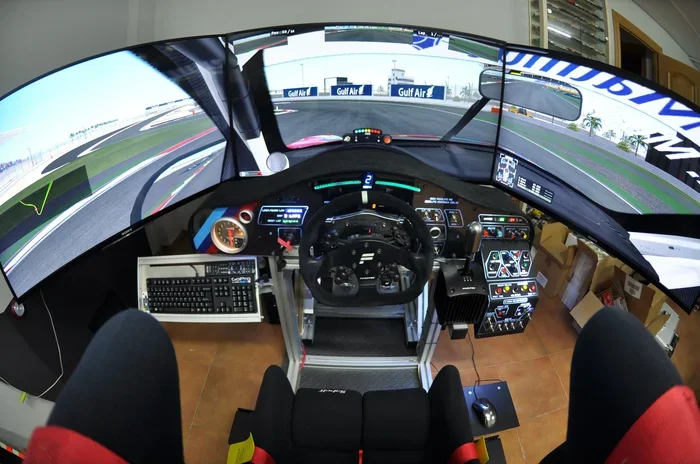
Your visuals create the world you race in. A great car racing simulator setup needs a display that pulls you in. There are two main paths: triple monitors or a VR headset.
Triple Monitor Setup
A triple monitor setup wraps your field of view. It feels like sitting in a real cockpit with a wide windshield. You can see more of the track, which helps you spot corners and rivals earlier.
Choose monitors with fast response times and good color accuracy. A 27-inch 144Hz monitor is a popular choice. Mount them on a curved or straight arm bracket depending on your preference. Make sure they are aligned at eye level to avoid neck strain.
VR Headset for Sim Racing
A VR headset takes immersion to the next level. You feel like you are actually inside the car. The depth perception and peripheral vision are unmatched. Games like Assetto Corsa Competizione and iRacing look incredible in VR.
However, VR comes with trade-offs. You need a powerful gaming PC to run VR smoothly. Some racers also experience motion sickness during long sessions. Start with short races and build your tolerance over time.
Single Monitor as a Budget Option
A single monitor is perfectly fine when you are just starting out. You can always upgrade later. The most important thing is that your monitor has a high refresh rate. A 120Hz or 144Hz display keeps motion smooth and responsive.
Optimizing Your Gaming PC and Software
All the hardware in the world means nothing if your gaming PC cannot keep up. A car racing simulator setup demands strong performance. You need smooth frame rates and detailed graphics without lag.
PC Hardware Requirements
Your graphics card is the most important component for sim racing. An NVIDIA RTX series or AMD Radeon RX series card handles modern sims with ease. Your processor also matters. A modern Intel or AMD CPU keeps the physics and AI running smoothly.
Do not forget about RAM. 16GB is the minimum for most sims. 32GB gives you headroom for future titles. A fast SSD ensures quick load times and smooth gameplay.
Software Settings and Force Feedback Tuning
Once your hardware is in place, tweak your software settings. Adjust the force feedback strength in your sim game. Start with the recommended settings and then fine-tune by feel. Too much feedback can be noisy. Too little makes the wheel feel flat.
Use telemetry tools to analyze your driving. These tools show you your braking points, throttle application, and corner speeds. Reviewing telemetry data helps you find areas to improve. Many serious sim racers rely on this data to get faster.
Quick tip: Update your wheel firmware and drivers regularly. Manufacturers often release updates that improve force feedback and fix bugs.
Fine-Tuning for the Best Racing Experience
Now that your car racing simulator setup is built, it is time to fine-tune. Small adjustments can make a big difference in how the system feels and performs.
Calibrating Your Wheel and Pedals
Take time to calibrate everything. Most sim games have a calibration menu. Run through it for your racing wheel and pedal set. This ensures that every input is accurate and consistent.
Adjusting Your Seat and Display Position
Sit in your sim cockpit and check your sightline. You should see the dashboard and the road ahead without leaning. Adjust your monitor height or VR position until everything feels natural. Your neck should stay relaxed during long sessions.
Building a Practice Routine
A great setup is only as good as how you use it. Build a practice routine that includes warm-up laps, sector time trials, and full race simulations. Track your progress over time. You will be amazed at how much faster you get with consistent practice on a quality sim racing rig.
Common Mistakes to Avoid
Here are some mistakes many beginners make when building a car racing simulator setup:
- Skipping the rig: A flimsy setup ruins the feel of even the best wheel.
- Ignoring pedal quality: Cheap pedals hold you back more than you think.
- Overlooking cable management: Tangled cables cause disconnections and frustration.
- Buying all at once: Spread your budget over time and prioritize the wheel first.
- Neglecting software updates: Outdated drivers and firmware can cause performance issues.
Avoid these pitfalls and your sim racing journey will be much smoother.
Final Thoughts on Building Your Car Racing Simulator Setup
Building the ultimate car racing simulator setup is a rewarding journey. You do not need to do it all at once. Start with a solid racing wheel and a stable rig. Add pedals, monitors, and software upgrades as your budget allows. Each piece you add brings you closer to a truly immersive racing experience.
The beauty of sim racing is that it grows with you. A beginner setup today can become a professional-grade rig tomorrow. The skills you develop on a quality sim racing platform translate to real-world driving awareness and car control. Many professional racing drivers started exactly where you are now.
Take your time. Enjoy the process. Test different configurations. Find what feels right for you. The best car racing simulator setup is the one that makes you want to climb in and race every single day. Now go build yours and hit the virtual track.
Frequently Asked Questions
What is the most important part of a car racing simulator setup?
The racing wheel is the most critical component. It gives you direct control and force feedback that makes the experience feel real. Start with a quality wheel and build the rest around it.
How much does a full car racing simulator setup cost?
Costs vary widely. A basic setup with a budget wheel and single monitor can start around $300. A pro setup with a direct drive wheel, triple monitors, and a custom rig can reach $3,000 or more. Build within your budget and upgrade over time.
Do I need a VR headset for sim racing?
No, a VR headset is not required. Many racers use a triple monitor setup or a single high-refresh-rate monitor. VR adds immersion but requires a powerful gaming PC and a higher budget.
Can I use a car racing simulator setup for other types of games?
Absolutely. Many sim racers use their setup for flight sims, space sims, and even driving games that support wheels. A sim cockpit is a versatile investment that enhances many gaming experiences.
How do I improve my lap times in sim racing?
Focus on telemetry analysis and consistent practice. Work on your braking points, throttle application, and cornering technique. A stable sim rig and responsive racing wheel also help you feel the car better and react faster.
Is a load cell brake pedal worth the extra cost?
Yes, a load cell brake is worth it for serious sim racers. It gives you precise braking control that a standard potentiometer pedal cannot match. Better braking leads to faster lap times and more realistic driving feel.
=== CONCLUSION ===
A well-built car racing simulator setup brings the thrill of racing right into your home. From choosing the right racing wheel to building a sturdy sim rig, every decision shapes your experience. Prioritize quality where it matters most, invest gradually, and enjoy the journey. With the right setup, every race feels like the real thing. Now get out there and build the setup of your dreams.