Which Car Make Sells the Most Vehicles in the World
Which Car Make Sells the Most Vehicles in the World? Toyota is the undisputed leader, moving over 10 million units annually. This article breaks down global vehicle sales data, top-selling car brands, and the factors behind the world’s best-selling car. You’ll learn why reliability, affordability, and smart global strategy keep Toyota at the top of the automotive industry sales charts.
Which Car Make Sells the Most Vehicles in the World? The answer is Toyota, and the gap is widening. Every year, millions of buyers around the globe choose Toyota over every other brand. This dominance isn’t a fluke. It’s the result of decades of smart planning, relentless focus on quality, and a deep understanding of what customers want.
The global automotive market is a massive, fast-changing landscape. Car sales statistics reveal clear patterns. Some brands sell millions of units in a single year, while others struggle to keep up. Understanding these numbers helps us see which manufacturers truly rule the road. In this article, we’ll explore the top-selling car brands, break down the numbers, and uncover the secrets behind the world’s best-selling car. You’ll walk away with a clear picture of the global vehicle sales race.
Key Takeaways
- Toyota is the global sales champion: The Japanese automaker has held the top spot for years, thanks to a massive lineup of reliable and affordable models.
- Volkswagen Group is the European leader: With brands like Volkswagen, Audi, and Skoda, the group sells nearly 9 million vehicles annually.
- American brands dominate the pickup segment: Ford, Chevrolet, and Ram drive strong U.S. sales, though their global reach is smaller.
- SUVs have overtaken sedans: Consumer preference has shifted toward taller, versatile vehicles across all major markets.
- Electric vehicles are reshaping the market: EV sales are growing fast, but Toyota still leads overall unit sales by a wide margin.
- Global strategy matters more than ever: Local assembly plants, supply chain mastery, and brand loyalty are key to winning the race.
📑 Table of Contents
Which Car Make Sells the Most Vehicles in the World?
The question of which car make sells the most vehicles in the world is more than just a trivia game. It shapes investment decisions, factory locations, and the models you see at your local dealership. When we look at vehicle sales by manufacturer, Toyota consistently sits at the top. The company’s ability to build cars that last, sell affordably, and meet local tastes has given it an unmatched edge. Let’s dive into the data and see how the leaders compare.
How Vehicle Sales Are Measured
Car sales statistics can be tricky. Not every sale is counted the same way. Most reports use “retail sales,” which means cars sold to end buyers. Some figures include fleet sales, like taxis and company cars. The global automotive market tracks both new and light commercial vehicles. For the purpose of this article, we focus on new passenger car and light truck sales. This gives us the clearest picture of consumer demand.
The Rise of Emerging Markets
Global car market growth no longer depends only on the United States and Europe. China and India are now the two biggest markets in the world. In China, Toyota sells more cars than any other foreign brand. In India, the company’s small, affordable hatchbacks fly off the shelves. These emerging markets are where much of the world’s population is buying their first car. That shift alone explains why the top-selling car manufacturer keeps changing its output to match local needs.
Toyota: The Undisputed Leader in Car Sales
Toyota is the best-selling car manufacturer on the planet. The company’s global vehicle sales topped 11 million units in recent years. That’s a staggering number. No other single brand comes close. The Toyota name is synonymous with reliability in almost every country. From the tiny Yaris to the massive Hilux pickup, the brand covers every segment of the market.
Why Toyota Dominates Global Sales
Several factors drive Toyota’s success. First, the company builds cars that last. A Toyota vehicle often clocks 300,000 miles with major repairs. That reputation draws buyers who want long-term value. Second, Toyota keeps costs low without cutting corners. The company’s production system, known as the Toyota Production System, minimizes waste and maximizes efficiency. Third, Toyota has a massive global footprint. It operates assembly plants on every continent. This localization strategy lets the company avoid tariffs and currency risks. The result is a steady stream of affordable, high-quality vehicles that sell in every major market.
Best-Selling Toyota Models
Toyota’s sales are spread across many models. The Corolla is the world’s best-selling car nameplate. The RAV4 leads the SUV segment. The Camry remains a sedan favorite in North America and the Middle East. The Hilux pickup dominates in Africa, Latin America, and Southeast Asia. In Australia, the HiLux and Ranger-like competitors are cultural icons. These models share common traits: they are practical, fuel-efficient, and easy to maintain. That formula has kept Toyota at the top of car sales data for decades.
Quick Tips for Understanding Toyota’s Success
- Focus on reliability and durability as the core selling points.
- Note how Toyota adapts models to local tastes, like offering diesel engines in Europe.
- Watch for the company’s investment in hybrid technology, which gives it a head start in fuel efficiency.
Volkswagen Group: The European Powerhouse
When we talk about the world’s best-selling car manufacturer, Toyota is the clear leader. But the Volkswagen Group is a strong second place. The group sells around 9 million vehicles a year. It includes the Volkswagen brand, Audi, SEAT, Skoda, and Lamborghini. This portfolio lets the group cover everything from budget cars to luxury SUVs.
Brand Portfolio and Market Strategy
Volkswagen Group’s strategy is all about breadth. The VW brand sells the Golf, Jetta, and Tiguan in Europe and China. Audi goes after premium buyers with the A4, A6, and Q5. Skoda offers value-priced versions of VW models in Eastern Europe and India. SEAT targets younger drivers in Spain and Latin America. This approach lets the group capture market share in dozens of countries. The group also benefits from deep ties to the Chinese market, where it partners with local automakers.
Volkswagen vs. Toyota: A Sales Comparison
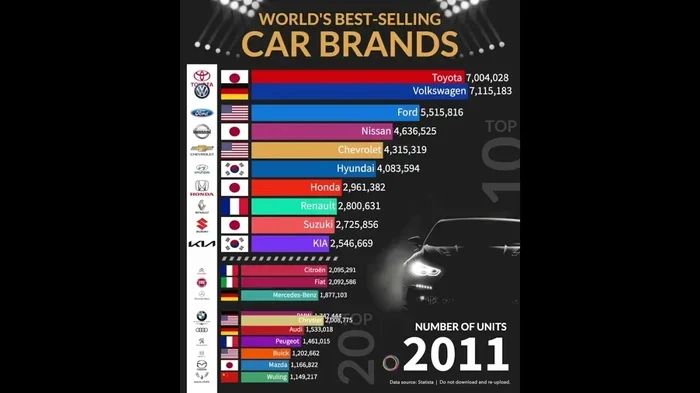
How do the top two compare? The table below shows a snapshot of recent global sales figures. Keep in mind that Volkswagen Group numbers include all its brands.
| Brand / Group | Approx. 2023 Global Sales (millions) | Key Market Strength |
|---|---|---|
| Toyota Motor Corporation | ~11.2 million | Global, especially Asia, Africa, and the Middle East |
| Volkswagen Group | ~9.2 million | Europe, China, and South America |
| Ford Motor Company | ~4.9 million | United States and China |
| General Motors (Chevrolet, Buick, GMC) | ~4.6 million | United States, China, and Latin America |
The gap between Toyota and Volkswagen Group is significant. Toyota sells about 2 million more vehicles each year. That difference comes down to the breadth of Toyota’s lineup and its strength in markets where Volkswagen has less presence. Still, Volkswagen Group’s growth in China and its premium brands make it a formidable competitor.
The American Giants: Ford, Chevrolet, and Ram
The United States has long been a powerhouse for car sales. Ford, Chevrolet, and Ram (part of Stellantis) dominate the domestic market. Together, they sell millions of vehicles every year in North America. However, their global reach is much smaller than Toyota’s or Volkswagen’s. These brands are heavily tied to the U.S. consumer and the demand for trucks and SUVs.
U.S. Market Dominance and Global Reach
Ford is the most recognizable American car brand worldwide. The F-Series pickup has been the best-selling vehicle in the United States for over 40 years. Chevrolet sells a wide range of cars, SUVs, and trucks, with the Silverado and Equinox leading the way. Ram Trucks, spun off from Dodge, focuses entirely on the pickup and van segments. These brands have strong dealer networks and deep brand loyalty in the U.S. But in Europe, Asia, and Africa, their sales volumes are modest. That limits their ability to challenge Toyota on a global scale.
Pickup Trucks Drive Sales
One reason the American giants sell so well is the pickup truck. In the U.S., pickups are the top-selling vehicle segment. They are used for work, recreation, and daily driving. The Ford F-150, Chevrolet Silverado, and Ram 1500 are household names. This segment is less important in other parts of the world, where smaller cars and SUVs dominate. Still, the success of the American brands in their home market is a powerful story in global automotive industry sales.
The Shift to SUVs and Electric Vehicles
The global car market is changing fast. Two trends are reshaping the sales landscape: the rise of SUVs and the growth of electric vehicles. These shifts affect which car make sells the most, because they change the types of vehicles people buy.
SUV Sales Overtake Sedans
For the past decade, SUV sales have grown steadily. Consumers around the world prefer the higher driving position, extra cargo space, and perceived safety of SUVs. Even in markets where small sedans once ruled, like Europe and Japan, SUVs now lead. Toyota’s RAV4 and Honda CR-V are among the best-selling models globally. This trend helps companies that can build profitable SUVs at scale. It also means that traditional sedan-focused brands must adapt quickly to stay relevant.
How EV Sales Are Changing the Game
Electric vehicle sales are rising, but they still represent a small share of total global vehicle sales. Tesla leads in pure electric cars, but legacy automakers are catching up. Hyundai, Kia, Volkswagen, and Toyota are all investing heavily in battery electric and plug-in hybrid models. Toyota’s hybrid technology has been a bridge technology for years. Now, the company is ramping up pure electric offerings. The shift to EVs could reshape the rankings in the coming decade. Brands that master battery technology and charging networks may leapfrog the current leaders.
Expert Insight: Why Toyota Keeps Winning
Industry analysts point to Toyota’s “multi-pathway” strategy. The company doesn’t bet everything on one technology. It sells gasoline, hybrid, plug-in hybrid, fuel cell, and battery electric vehicles. This flexibility lets Toyota sell more cars today while preparing for the future. The lesson for other automakers is clear: diversify your powertrain portfolio and meet customers where they are.
Key Factors Behind the World’s Best-Selling Car
What makes a car brand the world’s best-selling? It’s not just one thing. A mix of reliability, affordability, and global reach creates the conditions for massive sales. Let’s break down the key factors that separate the top sellers from the rest.
Reliability and Affordability
Buyers want cars that don’t break down and don’t drain their wallets. Toyota’s reputation for reliability is built on real-world data. Consumer Reports and J.D. Power consistently rank Toyota vehicles among the most dependable. At the same time, Toyota keeps prices competitive. A new Corolla or Yaris offers excellent value. This combination of durability and low cost is a powerful formula that drives repeat purchases and strong word-of-mouth.
Global Supply Chain Mastery
Building millions of cars a year requires a flawless supply chain. Toyota’s “just-in-time” production system means parts arrive exactly when needed. This reduces inventory costs and keeps factories running smoothly. The company also sources components from a network of trusted suppliers around the world. When a factory in Thailand faces a flood, Toyota can shift production to other plants. This resilience has been proven during natural disasters and trade disruptions. Few competitors can match this level of supply chain agility.
Common Mistakes When Comparing Car Sales
- Mistake 1: Comparing only one model year. Sales figures fluctuate. Look at rolling multi-year averages.
- Mistake 2: Ignoring group totals. Volkswagen Group sales include Audi, Skoda, and others. Always check whether the number is for a single brand or a group.
- Mistake 3: Overlooking regional differences. A brand that dominates in China may be weak in Europe. Global sales are the sum of many local stories.
- Mistake 4: Confusing units sold with revenue. A luxury brand like BMW can earn more money selling fewer cars than Toyota.
The world’s best-selling car is not just a single model. It’s a system of smart decisions, relentless quality, and global reach. Toyota has mastered this system. Other brands are learning from it. The race to sell the most vehicles is never static. New players, new technologies, and new markets will keep the competition fierce.
Conclusion
So, which car make sells the most vehicles in the world? The answer is clear: Toyota. The Japanese giant has earned this title through decades of hard work, smart strategy, and an unwavering focus on what buyers need. From the crowded streets of Shanghai to the farm roads of Africa, Toyota vehicles are everywhere. The company’s leadership in global vehicle sales is built on reliability, affordability, and a manufacturing footprint that spans the globe.
Volkswagen Group, Ford, and Chevrolet are strong contenders in their own right. They lead in specific regions and segments. But when it comes to total unit sales, no one matches Toyota. The shift toward SUVs and electric vehicles will test every automaker. Toyota’s multi-pathway approach gives it a head start. As the global automotive market evolves, one thing remains certain: the top-selling car manufacturer will be the one that listens to customers and delivers quality at scale. Keep an eye on the numbers, and you’ll see the story of the world’s best-selling car continues to unfold.
Frequently Asked Questions
Which car make sells the most vehicles in the world?
Toyota is the best-selling car manufacturer globally, with annual sales exceeding 11 million units. The company has held the top position for many years, thanks to its wide range of reliable and affordable models.
What is the world’s best-selling car model?
The Toyota Corolla is the world’s best-selling car nameplate. It has sold over 50 million units since its launch. Other top models include the Toyota RAV4, Ford F-Series, and Volkswagen Golf.
How are global vehicle sales measured?
Most reports track retail sales of new passenger cars and light trucks. Figures may include or exclude fleet sales, depending on the source. Organizations like OICA and individual automakers publish annual sales reports.
Why does Toyota sell so many cars?
Toyota’s success comes from a combination of reliability, affordability, and global production. The company builds cars that last, keeps costs low, and operates assembly plants on every major continent. This strategy gives it a huge advantage in emerging markets.
Are electric vehicles changing the top-selling car rankings?
EV sales are growing fast, but they still make up a small share of total vehicle sales. Toyota remains the overall leader in unit sales, but Tesla and Chinese EV makers are gaining ground. The rankings could shift significantly in the next decade.
Which car brand is the best-selling in the United States?
Ford is the best-selling car brand in the U.S., driven largely by the popularity of the F-Series pickup trucks. Chevrolet and Ram also rank highly. However, these brands have much smaller global sales compared to Toyota.