How Far Can You Drive on Min Oil in an Audi Without Damage
Driving on min oil in an Audi is risky but sometimes unavoidable. Most Audi models can travel roughly 50 to 100 miles on minimum oil before damage starts. However, this distance varies based on your engine type, driving conditions, and how fast the oil level drops. Always check your oil level regularly and top up immediately to prevent engine wear.
You are driving your Audi, and suddenly the dashboard lights up with an oil warning. Your heart sinks. How far can you actually drive on min oil in an Audi? This is a question many Audi owners face at some point. Whether you are stuck on a highway or in a remote area, knowing the answer could save your engine from serious harm.
The truth is, there is no single magic number. The distance you can drive depends on several factors. These include your Audi model, engine size, driving speed, and road conditions. Some Audis have bigger oil reservoirs than others. Some engines burn oil faster. In this guide, we will break down everything you need to know about driving on low oil in an Audi and how to protect your engine.
Audi vehicles are engineering marvels. They use precision-built engines that demand proper lubrication at all times. When oil drops to the minimum level, the engine starts running dry in certain areas. This creates friction between metal parts. Over time, this friction causes wear and can lead to expensive repairs. So let us dive deep into what happens when your oil is low and how far you can push it safely.
Key Takeaways
- Min oil means the level has hit the lowest acceptable mark on the dipstick. You should top up immediately.
- Most Audis can go 50-100 miles on min oil, but this is not recommended as a habit.
- Driving on low oil causes increased friction, overheating, and potential engine seizure.
- Oil pressure drops when oil is low, which accelerates wear on critical engine parts.
- Newer Audi models have oil level sensors that warn you before it becomes dangerous.
- Always carry a spare bottle of the correct oil for your Audi model.
- Regular oil changes and checks are the best way to avoid running low.
📑 Table of Contents
- What Does Min Oil Mean in an Audi?
- How Far Can You Drive on Min Oil in an Audi?
- What Happens When You Drive on Min Oil?
- How to Check Oil Level in Your Audi
- How to Top Up Oil Safely
- Common Mistakes Drivers Make with Low Oil
- How to Prevent Running Low on Oil
- When to See a Professional Mechanic
- Final Thoughts
What Does Min Oil Mean in an Audi?
When your Audi shows a min oil level indicator, it means the oil has dropped to the lowest safe mark. This is not the same as zero oil. There is still some oil in the system. But it is not enough to keep the engine fully protected at all times. The min mark on your dipstick is the bare minimum your engine needs to keep running.
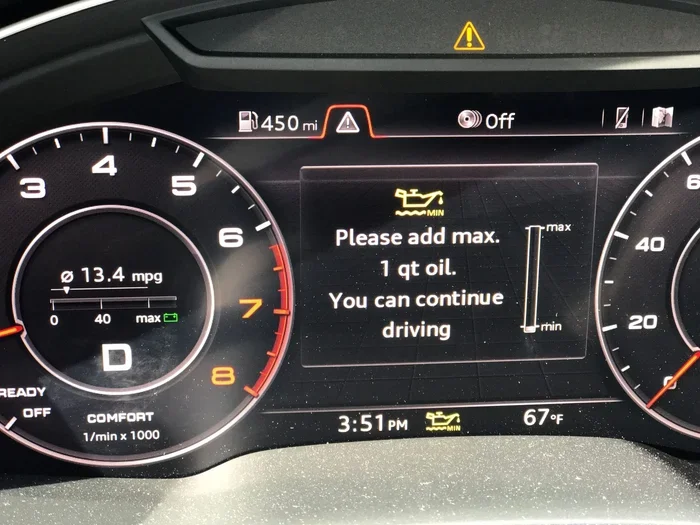
Most Audi models use a dipstick or an electronic oil level sensor. If you have an older Audi model, you will need to check the dipstick yourself. Newer models from around 2010 onwards often have electronic sensors. These sensors display the oil level on the dashboard or the MMI screen. Either way, when the system says min oil, it is time to take action.
How Oil Level Sensors Work in Audi Vehicles
Audi uses a combination of oil level sensors and oil pressure sensors. The oil level sensor measures how much oil is in the sump. The oil pressure sensor checks if the oil is circulating properly. When either sensor detects a problem, it triggers a warning light. Some Audis show a yellow oil symbol. Others show a red one. A yellow light means you should top up soon. A red light means you should stop driving immediately.
Understanding these warnings is crucial. Many drivers ignore the yellow light and keep going. This is a mistake. The yellow light is your first chance to fix the problem before it becomes serious. By the time the red light comes on, your engine may already be suffering.
How Far Can You Drive on Min Oil in an Audi?
This is the million-dollar question. The honest answer is that it depends. On average, an Audi can travel between 50 and 100 miles on minimum oil. But this range is very broad. Some drivers report going further. Others experience engine problems much sooner. Let us look at the factors that decide how far you can go.
Factors That Affect Driving Distance on Low Oil
Several things determine how far you can safely drive when your oil is at the min level:
- Engine Type: Audi makes several engine types. A 3000cc engine holds more oil than a smaller 1.8L or 2.0L engine. More oil means more reserve. So larger engines can sometimes go a bit further on min oil.
- Driving Style: Aggressive driving with high RPMs burns through oil faster. If you drive gently at low speeds, you will use less oil and may get a few extra miles.
- Road Conditions: Stop-and-go city driving puts more stress on the engine than smooth highway driving. City driving also causes the oil to heat up faster.
- Engine Temperature: A hot engine uses oil faster. If you are driving in summer or on a hot day, your oil level may drop more quickly.
- Oil Quality: Old or degraded oil breaks down faster. If your oil is past its change interval, it will not protect the engine as well even when the level is full.
- Oil Consumption Rate: Some Audi engines are known to consume oil. The 5 cylinder cars in India category includes some Audi models that burn oil faster than others. If your engine is a high oil consumer, min oil will become a problem sooner.
Real-World Distance Estimates by Audi Model
Here is a rough idea of how far different Audi models can go on min oil. Keep in mind these are estimates and should not be treated as a recommendation to drive on low oil.
- Audi A3 (1.4L or 2.0L): About 40 to 70 miles on min oil.
- Audi A4 (2.0L or 3.0L): About 50 to 90 miles on min oil.
- Audi A6 (2.0L or 3.0L): About 50 to 100 miles on min oil.
- Audi Q5 (2.0L or 3.0L): About 45 to 85 miles on min oil.
- Audi Q7 (3.0L or 4.0L): About 50 to 100 miles on min oil.
These numbers assume you are driving at moderate speeds and not pushing the engine hard. If you are driving aggressively or in extreme heat, reduce these estimates by about 20 to 30 percent.
What Happens When You Drive on Min Oil?
Driving on low oil is like running a machine without enough lubricant. The engine has many moving parts. These parts spin at thousands of revolutions per minute. Oil creates a thin film between these parts. This film prevents metal-to-metal contact. When oil is low, that film breaks down in certain areas.
Increased Engine Friction and Heat
When there is not enough oil, metal parts rub against each other. This creates friction. Friction generates heat. The engine starts to overheat. Over time, this heat warps metal components. It can cause the cylinder walls to scratch. It can also damage the bearings that support the crankshaft. All of this happens faster than most people realize.
Oil Pressure Drops
Oil needs to be at a certain level to maintain proper pressure. When the oil level drops to min, the oil pump starts sucking air along with oil. This reduces oil pressure. Low oil pressure means oil is not reaching all parts of the engine. The top of the engine and the camshaft area are the first to suffer. Without proper oil pressure, these parts can seize up quickly.
Engine Wear and Tear
Even short trips on min oil cause wear. The wear may not be visible right away. But over time, it adds up. You might notice increased engine noise. You might see blue or grey smoke from the exhaust. These are signs that your engine is suffering from low oil. If you ignore these signs, the damage can become permanent.
Risk of Engine Seizure
In the worst case, driving on min oil can cause engine seizure. This happens when the engine overheats so much that the metal parts warp and fuse together. A seized engine means the car stops completely. Repairing or replacing a seized engine costs thousands of dollars. In many cases, it is not worth it.
Audi engines are expensive to repair. A new engine for an Audi A4 or Q5 can cost anywhere from 5 to 15 lakhs depending on the model. This is why it is so important to never ignore the min oil warning. Even a short drive on low oil can cause damage that adds up over time.
How to Check Oil Level in Your Audi
Checking your oil level regularly is the best way to avoid running low. Here is how you can do it for different Audi models.
Using the Dipstick (Older Audi Models)
If your Audi has a dipstick, follow these steps:
- Park the car on a flat surface.
- Turn off the engine and wait for 5 to 10 minutes.
- Open the hood and locate the dipstick.
- Pull the dipstick out and wipe it clean with a cloth.
- Insert it back fully and pull it out again.
- Check the oil level against the min and max marks.
- If the oil is near or below the min mark, top up immediately.
Using the Electronic Sensor (Newer Audi Models)
For newer Audi models with electronic oil level sensors:
- Turn on the ignition without starting the engine.
- Go to the vehicle status menu on the dashboard or MMI screen.
- Look for the oil level indicator.
- If it shows min or low, you need to add oil.
Which Oil to Use for Your Audi
Not all oils are the same. Audi engines require specific oil grades. Most modern Audis use 5W-30 or 5W-40 synthetic oil. Check your owner’s manual for the exact specification. Using the wrong oil can cause poor lubrication and even engine damage. Always use oil that meets the Volkswagen Group standards (VW 502 00 or 504 00).
How to Top Up Oil Safely
If you find yourself at min oil, here is what you should do:
- Find a safe place to pull over. Do not keep driving if the oil light is red.
- Check the oil level with the dipstick or sensor. Confirm it is actually low.
- Add the correct oil type. Use the grade recommended for your Audi model.
- Add oil slowly. Pour a small amount at a time. Check the level after each addition.
- Do not overfill. Too much oil can also cause problems. It can cause foaming and reduced lubrication.
- Drive to the nearest service center. Even after topping up, get your oil changed or checked by a professional.
Always carry a bottle of the correct oil in your trunk. This is a simple habit that can save you from a lot of trouble. A 1-litre bottle of 5W-30 synthetic oil is small enough to keep in the boot. It weighs very little and takes up minimal space.
Common Mistakes Drivers Make with Low Oil
Many drivers make mistakes when they notice low oil. Here are some common ones to avoid:
- Ignoring the warning light: This is the biggest mistake. The oil light is there to protect your engine. Ignoring it can lead to catastrophic damage.
- Topping up with the wrong oil: Mixing oil types can reduce performance. Always use the oil grade recommended by Audi.
- Waiting too long to top up: Even 10 minutes of driving on min oil can cause damage. Do not wait until you reach your destination.
- Overfilling the oil: Too much oil creates pressure inside the engine. It can damage seals and gaskets.
- Not checking for leaks: If your oil keeps dropping, you may have a leak. Get it checked by a mechanic.
How to Prevent Running Low on Oil
Prevention is always better than cure. Here are some tips to keep your Audi’s oil at the right level:
- Check oil weekly: Make it a habit to check your oil level every week. It takes less than five minutes.
- Follow the oil change schedule: Audis need oil changes every 10,000 to 15,000 km or once a year. Stick to this schedule.
- Monitor oil consumption: If your Audi burns oil faster than normal, get it inspected. Some engines consume up to 1 litre per 1,000 km, but more than that is a problem.
- Watch for warning signs: Unusual engine noise, blue exhaust smoke, or a burning smell are all signs of oil problems.
- Keep a maintenance log: Track your oil changes and top-ups. This helps you spot patterns and catch problems early.
Audi is a premium brand known for its 5 star cars in India safety ratings and high-performance engines. But even the best engines need proper care. Regular oil maintenance is one of the simplest and most effective ways to keep your Audi running smoothly for years.
Audi vehicles often come with engines in the 2 litre to 3000cc range. These powerful engines need the right amount of clean oil to perform at their best. Neglecting oil levels is one of the fastest ways to shorten your engine’s lifespan. A well-maintained Audi can easily last 200,000 km or more with proper care.
When to See a Professional Mechanic
Sometimes, low oil is a symptom of a bigger problem. If you find yourself topping up oil frequently, something may be wrong. Here are signs that you need professional help:
- Oil level drops significantly within a few hundred kilometres.
- You see oil spots under your parked car.
- The engine makes knocking or ticking sounds.
- Oil pressure warnings come on even after topping up.
- Blue or grey smoke comes from the exhaust.
A mechanic can check for oil leaks, worn piston rings, or damaged oil seals. Catching these issues early can save you from expensive repairs later.
Final Thoughts
So how far can you drive on min oil in an Audi? The short answer is 50 to 100 miles at most. But the better question is, why would you want to? Driving on low oil is a gamble with your engine. Even a short distance can cause damage that builds up over time. The best approach is simple: check your oil regularly, top up when needed, and never ignore the warning lights.
Your Audi is a precision machine. It deserves the best care you can give it. Treat the oil system with respect, and your engine will reward you with years of reliable performance. Remember, a few minutes of oil checking can save you from hours of downtime and thousands of rupees in repairs.
Keep your oil at the right level. Drive safely. And enjoy every mile in your Audi.
Frequently Asked Questions
Can I drive 50 km on min oil in my Audi?
Yes, most Audi models can cover 50 km on min oil without immediate damage. However, this should never become a habit. Even a short distance on low oil increases engine friction and wear. Always top up your oil before the level reaches the min mark.
What happens if I drive on low oil for a long time?
Driving on low oil for an extended period causes increased friction, overheating, and accelerated wear on engine components. Over time, this can lead to bearing damage, cylinder scoring, and even engine seizure. The repair costs for such damage can be very high.
How often should I check my Audi’s oil level?
You should check your Audi’s oil level at least once a week. It is a quick and easy process that takes less than five minutes. Regular checks help you catch low oil levels before they cause any damage to the engine.
Can low oil cause the check engine light to come on in an Audi?
Yes, low oil can trigger the check engine light in some Audi models. The oil pressure sensor detects when oil levels are too low and sends a warning to the ECU. This may illuminate the check engine light or the oil warning light on the dashboard.
Is it normal for an Audi to consume oil between changes?
Some oil consumption is normal for Audi engines. Most manufacturers consider up to 1 litre per 1,000 km as acceptable. However, if your Audi is using more oil than this, it could indicate a problem such as worn piston rings or oil leaks. Get it inspected by a qualified mechanic.
What type of oil should I use for my Audi engine?
Most modern Audi engines require synthetic 5W-30 or 5W-40 oil that meets VW 502 00 or 504 00 specifications. Always refer to your Audi owner’s manual for the exact oil grade recommended for your specific model and engine type.