Everything You Need to Know About Car Lift for Garage
A car lift for garage transforms any home workshop into a professional-grade workspace. Whether you need a two-post lift for quick tire changes or a four-post lift for long-term storage, this guide covers everything from types and costs to installation and safety. You will learn how to pick the right lift for your space, budget, and DIY goals.
A car lift for garage use is one of the best upgrades a car lover can make. It opens up a world of convenience. You can change oil, swap tires, or inspect brakes without bending over a jack stand. It also frees up valuable floor space in your garage. Whether you are a weekend wrench-turner or a full-time gearhead, a lift changes how you work on your vehicle.
But choosing the right lift is not as simple as picking one off a shelf. There are many types, sizes, and price points. Each lift has its own strengths. Some are great for quick jobs. Others handle heavy-duty projects. This guide breaks down everything you need to know. You will learn about the different kinds of lifts, how to choose the right one, what installation looks like, and how to stay safe. Let us dive in.
Key Takeaways
- Multiple lift types exist: two-post, four-post, scissor, and overhead lifts each serve different garage needs.
- Weight capacity matters most: always choose a lift rated above your vehicle’s curb weight.
- Installation requires planning: floor strength, ceiling height, and electrical access are critical factors.
- Costs range widely: from $1,000 for portable lifts to $7,000+ for premium two-post models.
- Safety is non-negotiable: regular maintenance and proper locking mechanisms prevent accidents.
- DIY installation is possible: but professional setup ensures warranty protection and optimal performance.
- Small garages can still use lifts: low-profile and scissor designs fit tight spaces.
📑 Table of Contents
- What Is a Car Lift for Garage Use?
- Types of Car Lifts for Your Garage
- How to Choose the Right Car Lift for Garage Setup
- Car Lift Installation Tips and Requirements
- Car Lift Cost: What to Expect
- Safety Tips for Using a Car Lift
- Common Mistakes to Avoid
- Quick Tips for Getting the Most Out of Your Car Lift
- Expert Insights on Car Lifts
- Final Thoughts
What Is a Car Lift for Garage Use?
A garage car lift is a mechanical device that raises your vehicle off the ground. It gives you full access to the underside of your car or truck. Most lifts use hydraulic power, electric motors, or a combination of both. They are built with strong steel frames and locking mechanisms to hold your vehicle securely at height.
Home garage lifts have come a long way over the years. Older models were bulky and loud. Today’s lifts are compact, quiet, and easy to operate. Many fit in a standard two-car garage without eating up all your space. The key is finding the right vehicle lift for your specific setup and needs.
Why Install a Lift in Your Garage?
There are many reasons to add a car lift for garage projects. Here are the top benefits:
- Better access: You can reach every bolt, bracket, and component with ease. No more awkward positions on the cold garage floor.
- Faster work: Raising and lowering your vehicle takes seconds. This saves you huge amounts of time during repairs.
- More space: With the car in the air, you gain floor space for storage or additional work areas.
- Professional results: A level, stable platform helps you do cleaner, more accurate work.
- Safety: A quality lift holds your vehicle firmly in place, reducing the risk of it falling or shifting.
Types of Car Lifts for Your Garage
Not all lifts are the same. Each type has a unique design and purpose. Understanding the differences helps you make the best choice for your garage.
Two-Post Car Lift
The two-post hydraulic lift is the most popular choice for home garages. It uses two vertical posts with arms that cradle your vehicle. You drive the car onto a small platform, and the lift raises it between the two posts.
Two-post lifts come in two styles: symmetrical and asymmetrical. Symmetrical lifts place the arms evenly on both sides. This works well for most vehicles. Asymmetrical lifts offset the arms. They give you more door clearance, which is great if you park close to your lift.
Pros:
- Saves floor space
- Easy to operate
- Great for tire changes and oil changes
- Low-profile options available
Cons:
- Requires good ceiling height (at least 10 feet)
- Can be noisy during operation
- Weight capacity varies by model
Four-Post Car Lift
A four-post lift uses four vertical columns and a flat platform. Your vehicle drives directly onto the platform. This design is extremely stable and can handle heavy vehicles like trucks and SUVs.
Four-post lifts are ideal for long-term storage or projects that require the car to stay raised for extended periods. Many people also use them as overhead lift alternatives for engine work.
Pros:
- Handles heavy vehicles with ease
- Very stable and secure
- Great for storage and long projects
- Quieter operation than two-post lifts
Cons:
- Takes up more floor space
- Higher cost for quality models
- Platform can be slippery without grip pads
Scissor Lift
A scissor lift uses a folding crisscross mechanism to raise the platform. It is compact and folds flat when lowered. This makes it perfect for garages with limited ceiling height.
Scissor lifts are great for lighter vehicles and smaller maintenance tasks. They are popular in tight garages where a two-post or four-post lift would not fit. The low-profile scissor lift is a favorite among homeowners with low-clearance garages.
Pros:
- Folds flat for easy storage
- Fits in low-ceiling garages
- Affordable price point
- Simple to install
Cons:
- Lower weight capacity
- Not ideal for heavy trucks or SUVs
- Smaller platform size
Overhead Garage Lift
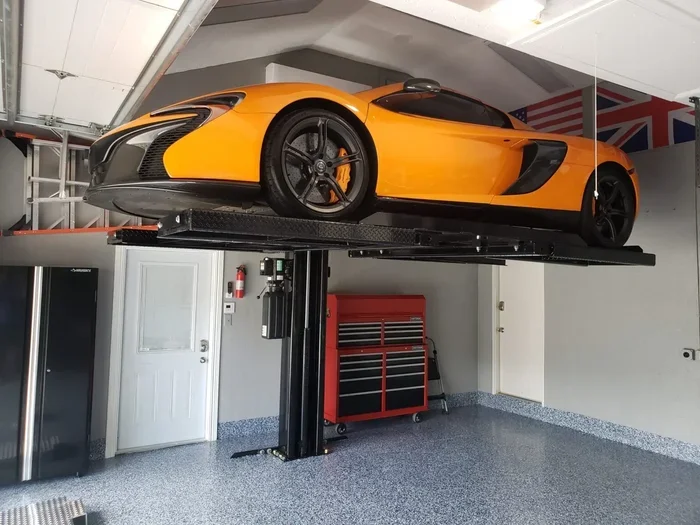
An overhead lift raises your vehicle and stores it against the ceiling. This frees up nearly all the floor space in your garage. It is a great option if you have multiple vehicles or need maximum floor space.
Overhead lifts use a chain or cable system to hoist the vehicle. They require strong ceiling joists or a reinforced roof structure. Installation is more complex, but the payoff is huge in terms of usable garage space.
Pros:
- Maximizes floor space
- Great for multi-car garages
- Keeps your vehicle out of the way
Cons:
- Requires ceiling reinforcement
- More expensive than other types
- Installation is more involved
Portable Car Lift
A portable car lift is a lightweight, mobile option. It does not require permanent installation. You can move it around your garage or even take it to a friend’s house.
Portable lifts are perfect for renters or people who do not want to modify their garage. They typically have lower weight capacities, but they work well for sedans and small SUVs. The portable hydraulic lift is a popular choice for quick tire rotations and minor repairs.
How to Choose the Right Car Lift for Garage Setup
Choosing the right car lift for garage setup depends on several factors. Let us walk through the most important ones.
Consider Your Vehicle Weight
Check your vehicle’s curb weight before buying a lift. Curb weight is the total weight of your car with a full tank of gas but no passengers. Most lift manufacturers list a weight capacity for each model.
Always choose a lift rated for at least 25% more than your vehicle’s weight. This gives you a safety buffer. For example, if your car weighs 3,500 pounds, look for a lift rated for 4,000 pounds or more.
Measure Your Garage Space
Your garage size determines which lift you can use. Measure both the floor space and the ceiling height. A two-post lift needs at least 10 feet of ceiling clearance. A scissor lift works well in garages with 8 to 9 feet of height.
Also consider the floor surface. Concrete floors are ideal. Avoid installing a lift on cracked or uneven concrete, as this can compromise safety and stability.
Think About Your Projects
What kind of work will you do? If you mainly change oil and tires, a basic two-post lift works great. If you plan to do full engine rebuilds or body work, a four-post lift gives you more stability and floor space.
Make a list of the jobs you want to tackle. This helps you match the lift to your actual needs rather than buying more than you require.
Budget Considerations
Car lift cost varies a lot depending on the type and brand. Here is a general price breakdown:
- Portable lifts: $500 to $1,500
- Scissor lifts: $1,000 to $3,000
- Two-post lifts: $2,000 to $6,000
- Four-post lifts: $2,500 to $7,000
- Overhead lifts: $3,000 to $8,000
Remember to factor in installation costs if you hire a professional. Some brands include free installation with purchase, so always ask.
Brand and Warranty Matters
Stick with reputable brands when buying a garage car lift. Look for manufacturers with strong warranties and good customer reviews. A solid warranty protects you from defects and gives you peace of mind.
Brands like Ranger, BendPak, and Rotary are well-known in the industry. They offer reliable products with strong build quality. Read car lift reviews online before making your final decision.
Car Lift Installation Tips and Requirements
Installing a car lift for garage is a big project. Proper installation ensures safety and extends the life of your lift. Here is what you need to know.
Floor Strength and Preparation
Your garage floor must be strong enough to support the lift and your vehicle. Most residential concrete floors can handle a car lift, but the slab must be at least 4 inches thick. If your floor is thinner or has cracks, consult a structural engineer before installation.
Before installation, clean the floor thoroughly. Remove any debris, grease, or oil. The lift must sit on a flat, level surface. Use a spirit level to check the floor before you begin.
Electrical Requirements
Most hydraulic and electric lifts need a dedicated electrical circuit. A 220V outlet is common for two-post and four-post lifts. Make sure your garage has the proper electrical setup before the lift arrives.
If you are not sure about your electrical capacity, hire a licensed electrician. They can install a dedicated circuit safely and up to code.
Professional vs. DIY Installation
You can install many car lifts yourself if you are handy. However, professional installation has clear advantages:
- Guaranteed proper setup and alignment
- Warranty protection (some brands require pro installation)
- Safety inspection included
- Faster, cleaner installation process
If you choose the DIY route, follow the manufacturer’s manual exactly. Take your time and double-check every bolt and connection. Never skip safety steps.
Ceiling Height and Clearance
Ceiling height is one of the most overlooked factors in lift selection. Measure from the floor to the underside of your ceiling joists. Subtract at least 12 inches for safety clearance.
For example, if your ceiling is 9 feet high, you have about 84 inches of usable space. A low-profile two-post lift needs roughly 78 to 84 inches of clearance. Always check the lift’s specifications before purchasing.
Car Lift Cost: What to Expect
The car lift cost depends on the type, brand, and features. Here is a detailed look at what you can expect to pay.
Budget-Friendly Options
If you are on a tight budget, a scissor lift or portable lift is your best bet. These models cost between $500 and $3,000. They handle basic maintenance tasks and light-duty vehicles well.
Keep in mind that cheaper models may have lower weight capacities and fewer safety features. Always check the specifications carefully.
Mid-Range Lifts
Mid-range two-post and four-post lifts cost between $2,500 and $5,000. These models offer a great balance of features, durability, and price. They work well for most home garages and handle a wide range of vehicles.
Premium Lifts
Premium lifts with advanced features cost $5,000 to $8,000 or more. Look for features like wireless controls, automatic leveling, and silent hydraulic systems. These lifts are built for heavy use and offer the best long-term value.
Hidden Costs to Consider
Beyond the purchase price, consider these additional costs:
- Installation fees: $200 to $1,000 depending on complexity
- Electrical upgrades: $150 to $500 for a dedicated circuit
- Floor reinforcement: $500 to $2,000 if your slab needs strengthening
- Maintenance supplies: $50 to $100 per year for hydraulic fluid and lubricants
Safety Tips for Using a Car Lift
Safety must always come first when using a car lift for garage projects. A lift holds thousands of pounds of metal above your head. Treat it with respect and care.
Regular Maintenance Checks
Inspect your lift before every use. Check for leaks, unusual noises, or loose bolts. Lubricate moving parts according to the manufacturer’s schedule. A well-maintained lift lasts for decades and operates safely.
Always Use Locking Mechanisms
Never rely on the lift alone to hold your vehicle. Always engage the locking mechanism before getting under the car. Most quality lifts have automatic locking arms or mechanical locks. Use them every single time.
Distribute Weight Evenly
Place your vehicle centered on the lift platform. Uneven weight distribution can cause the lift to tilt or become unstable. Follow the alignment marks on the platform for proper positioning.
Keep the Area Clear
Remove all tools, cords, and clutter from the area beneath the lift. Never let anyone stand under a raised vehicle unless they are on a stable work surface with proper support.
Train Everyone Who Uses the Lift
If you have family members or friends who use the lift, make sure they know how to operate it safely. Show them the locking mechanism, the emergency release, and the weight limits. A little training goes a long way in preventing accidents.
Common Mistakes to Avoid
Even experienced car enthusiasts make mistakes with their lifts. Here are the most common errors and how to avoid them.
Skipping the Weight Rating Check
Never exceed the lift’s rated capacity. Overloading a lift is extremely dangerous and can cause catastrophic failure. Always check your vehicle’s weight and compare it to the lift’s specifications.
Ignoring Floor Conditions
Installing a lift on a damaged or weak floor is a serious mistake. Cracks, chips, or thin concrete can compromise the entire setup. Inspect your floor thoroughly before installation.
Buying Without Measuring
Do not buy a lift without measuring your garage first. A lift that is too tall, too wide, or too long will not fit. Bring your measurements when you shop, and double-check them against the lift’s dimensions.
Neglecting Maintenance
Skipping regular maintenance leads to expensive repairs and safety hazards. Stick to the manufacturer’s maintenance schedule. Change hydraulic fluid, check bolts, and inspect cables on a regular basis.
Quick Tips for Getting the Most Out of Your Car Lift
- Paint your garage floor: A painted or coated floor protects against oil spills and makes cleanup easier.
- Add a work light: A bright LED light mounted above the lift improves visibility for detailed work.
- Use wheel chocks: Always place wheel chocks behind your tires when the car is on the lift.
- Keep a fire extinguisher nearby: Always have one within arm’s reach when working on your vehicle.
- Store your manual safely: Keep the lift’s instruction manual in a dry, accessible place for future reference.
- Join online communities: Forums and groups dedicated to garage lifts are great sources of tips and troubleshooting advice.
Expert Insights on Car Lifts
Professional mechanics and garage designers agree on a few key points. First, always buy the best lift you can afford. A cheaper lift may save money upfront but could cost more in repairs and safety risks over time. Second, prioritize floor space and ceiling height. These two factors determine which lifts are even an option for your garage.
Many experts also recommend choosing a lift with a low-profile design if your garage has limited height. Modern low-profile lifts can raise a vehicle several feet even with only 8 feet of ceiling clearance. This opens up options for homeowners who previously thought a lift was not possible.
Finally, do not overlook the importance of lift maintenance. Even the best lift will wear down without proper care. Schedule a professional inspection once a year to catch potential issues early.
Final Thoughts
A car lift for garage is more than a convenience. It is a game-changer for anyone who works on their own vehicles. The right lift saves time, improves safety, and makes every project easier and more enjoyable.
Take the time to research your options. Consider your garage size, vehicle weight, and project needs. Choose a reputable brand with solid warranty support. And never compromise on safety. With the right setup, your garage will feel like a professional auto shop. You will wonder how you ever worked without one.
Start your search today. Compare models, read reviews, and picture your garage transformed. A car lift for garage use opens up a whole new world of possibility. Your future self will thank you for making the investment.
Frequently Asked Questions
What is the best car lift for a small garage?
A scissor lift or low-profile two-post lift is ideal for small garages. These models have a compact footprint and require less ceiling height. Measure your space carefully before buying to ensure a proper fit.
How much does it cost to install a car lift?
Installation costs typically range from $200 to $1,000. The price depends on the lift type, your garage’s electrical setup, and whether you hire a professional. Some manufacturers include free installation with their lifts.
Can I install a car lift myself?
Yes, many homeowners install car lifts themselves if they are comfortable with basic construction and electrical work. However, professional installation is recommended for safety and to maintain your warranty.
What weight capacity do I need for a car lift?
Choose a lift rated for at least 25% more than your vehicle’s curb weight. Most standard cars weigh between 3,000 and 4,500 pounds. A lift rated for 6,000 to 9,000 pounds will handle most passenger vehicles comfortably.
How often should I maintain my car lift?
Inspect your lift before each use and perform a full maintenance check every six months. Change hydraulic fluid annually and lubricate all moving parts regularly. Consistent maintenance keeps your lift running safely for years.
Do I need a special electrical outlet for a car lift?
Most two-post and four-post lifts require a 220V dedicated circuit. Check the lift’s specifications before purchasing. If your garage does not have the right outlet, hire a licensed electrician to install one safely.
=== CONCLUSION ===
A car lift for garage is one of the smartest investments any car owner can make. It transforms your workspace, boosts your productivity, and makes vehicle maintenance safer and more enjoyable. From choosing the right type to proper installation and ongoing maintenance, this guide has covered everything you need to know.
Remember to prioritize safety, match the lift to your garage and vehicle, and never skip regular maintenance. With the right garage car lift, you will work smarter, not harder. Start planning your setup today and enjoy the difference a quality lift makes.