A Car Starts From Rest and Accelerates Uniformly Explained
When a car starts from rest and accelerates uniformly, it begins at zero speed and gains velocity at a steady rate over time. This fundamental concept in motion physics helps you understand how vehicles build speed, how far they travel, and what forces are at work. By learning the key equations and graphs, you can solve any problem related to uniformly accelerated motion with confidence.
Have you ever wondered what happens when a car starts from rest and accelerates uniformly? It is one of the most fundamental ideas in motion physics, and it shows up everywhere from everyday driving to high-performance racing. When a vehicle begins at zero speed and picks up pace at a steady, unchanging rate, something predictable and beautiful happens. The math becomes clean, the graphs become simple straight lines, and you can calculate exactly where the car will be at any moment in time.
This concept is not just for textbook problems. Understanding how a car starts from rest and accelerates uniformly helps you grasp real-world car performance, safety braking distances, and even how engineers design engines. Whether you are a student studying physics, a car enthusiast curious about speed, or someone who just wants to understand the world better, this guide breaks it all down in plain language. Let us walk through everything step by step.
Key Takeaways
- Starting from rest means initial velocity is zero: This simplifies all the equations and makes calculations much easier to understand.
- Uniform acceleration means a constant rate of speed increase: The car gains the same amount of speed every second, which is key to solving motion problems.
- Three kinematic equations handle all scenarios: These formulas let you find final velocity, distance traveled, and time with just a few known values.
- Velocity-time graphs reveal the story of motion: The slope gives you acceleration, and the area under the line gives you displacement.
- Real-world car performance relies on these principles: From sports cars to everyday vehicles, uniform acceleration shapes how cars behave on the road.
- Avoiding common mistakes saves time and errors: Mixing up initial and final velocity or forgetting to convert units are the top pitfalls to watch for.
📑 Table of Contents
- What Does It Mean When a Car Starts From Rest and Accelerates Uniformly?
- The Key Equations Behind Uniform Acceleration
- How Far Does the Car Travel During Uniform Acceleration?
- Velocity-Time Graphs: Visualizing the Motion
- Real-World Examples of Uniform Acceleration in Cars
- Common Mistakes and Expert Insights
- Comparing Uniform and Non-Uniform Acceleration
- Putting It All Together: A Complete Example Problem
- Conclusion
What Does It Mean When a Car Starts From Rest and Accelerates Uniformly?
Let us start with the basics. When we say a car starts from rest, we mean the vehicle is completely still at the beginning. Its initial velocity is zero. There is no movement whatsoever before the driver presses the accelerator. This is a crucial starting point because it simplifies every calculation you will ever do with these problems.
Now, what about uniform acceleration? This means the car gains speed at a constant rate. Every second, the speed increases by exactly the same amount. If the acceleration is 3 meters per second squared, then after one second the car moves at 3 m/s, after two seconds at 6 m/s, after three seconds at 9 m/s, and so on. The rate of change of speed never fluctuates. It stays perfectly steady from start to finish.
Defining Rest and Acceleration in Simple Terms
Think of it like this. Imagine you are sitting in a parked car at a red light. The speedometer reads zero. That is rest. Now the light turns green and you press the gas pedal. If you push the pedal just enough to keep the speed rising by the same amount each second, you are creating uniform acceleration. The car starts from rest and accelerates uniformly, and everything follows a smooth, predictable pattern.
In physics language, rest means zero initial velocity, and uniform acceleration means a fixed value of acceleration that does not change over the time interval of interest. Together, these two conditions create the simplest and most solvable type of motion problem you will encounter.
Why This Concept Matters in Automotive Physics
You might ask why this matters so much. The answer is that most real-world driving scenarios start from a stop. When a car pulls out of a parking space, merges onto a highway, or launches from a standing start at a traffic light, it begins from rest. Understanding how quickly it can build speed tells you a lot about the vehicle’s capabilities.
Car manufacturers use these exact principles to rate engine performance. They measure how fast a car can go from zero to sixty miles per hour, and that is essentially a study of a car starting from rest and accelerating uniformly over a specific acceleration time. The smoother and faster the acceleration, the better the car performs.
The Key Equations Behind Uniform Acceleration
Here is where things get really useful. There are three main equations of motion that describe what happens when a car starts from rest and accelerates uniformly. These are often called the kinematic equations, and they connect five key variables: initial velocity, final velocity, acceleration, time, and displacement.
Since the car starts from rest, the initial velocity is always zero. This makes the equations much simpler. Let us look at each one.
First Equation of Motion: Final Velocity
The first equation relates final velocity to acceleration and time. It looks like this:
v = u + at
In this formula, v stands for final velocity, u is the initial velocity, a is acceleration, and t is the time elapsed. Since the car starts from rest, u equals zero. So the equation becomes simply v = at. This tells you that the final speed is just the acceleration multiplied by the time spent accelerating.
For example, if a car accelerates at 4 meters per second squared for 5 seconds, its final velocity is 4 times 5, which equals 20 meters per second. Clean and straightforward.
Second Equation of Motion: Distance Traveled
The second equation helps you find how far the car goes during the acceleration period:
s = ut + ½at²
Again, since u is zero, this simplifies to s = ½at². The distance traveled equals half the acceleration multiplied by the square of the time. Notice how time gets squared, which means small increases in time lead to much larger increases in distance.
If that same car accelerates at 4 m/s² for 5 seconds, the distance is half of 4 times 25, which gives you 50 meters. The car covers half a football field in just five seconds.
Third Equation of Motion: Velocity and Displacement
The third equation connects final velocity directly to distance, without needing time:
v² = u² + 2as
With zero initial velocity, this becomes v² = 2as. This is incredibly handy when you know the distance but not the time, or vice versa.
Using our example, if the car traveled 50 meters with an acceleration of 4 m/s², the final velocity squared equals 2 times 4 times 50, which is 400. The square root of 400 is 20 m/s, matching our earlier result perfectly.
How Far Does the Car Travel During Uniform Acceleration?
Calculating distance is one of the most common questions people have about a car starting from rest and accelerating uniformly. The good news is that the math is very manageable once you understand the pattern.
The key insight is that distance depends on the square of time. This means that doubling the acceleration time does not just double the distance. It actually quadruples it. A car accelerating for 10 seconds covers four times the distance it covers in 5 seconds, assuming the same constant acceleration.
Calculating Displacement Step by Step
Let us walk through a practical example together. Imagine a compact sedan that accelerates from a stoplight at a steady 2.5 meters per second squared. You want to know how far it travels in 8 seconds.
First, identify what you know. The initial velocity is zero because the car starts from rest. The acceleration is 2.5 m/s². The time is 8 seconds. Now plug these into the second equation of motion: s = ½ times 2.5 times 8 squared. That gives you s = ½ times 2.5 times 64, which equals 80 meters.
So the car travels 80 meters from the stoplight in 8 seconds. That is a very reasonable distance for a normal city driving acceleration.
Quick Tips for Solving Distance Problems
- Always confirm the car starts from rest: This means initial velocity equals zero, which simplifies every equation dramatically.
- Convert all units before calculating: Make sure time is in seconds, distance in meters, and acceleration in meters per second squared.
- Use the simplified equations: With zero initial velocity, you only need v = at and s = ½at². No need for the full versions.
- Double-check your squared terms: Time squared is a common place to make arithmetic errors, so be careful.
Velocity-Time Graphs: Visualizing the Motion
One of the most powerful tools for understanding a car starting from rest and accelerating uniformly is the velocity-time graph. This simple visual makes everything click, and once you learn to read it, you will never forget the concepts.
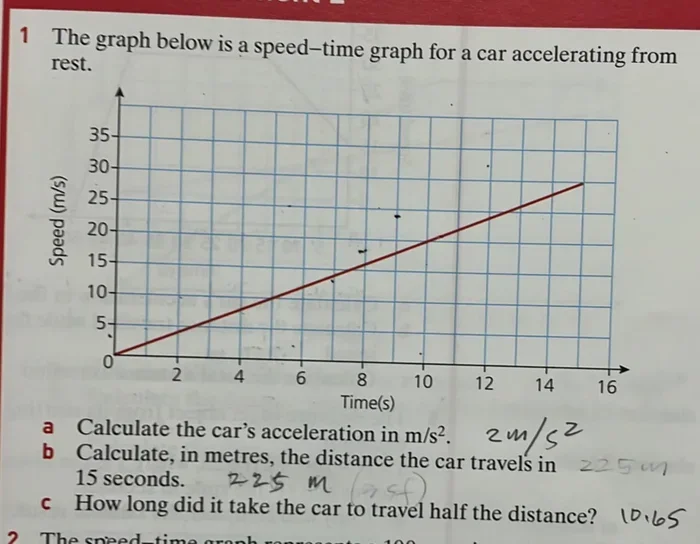
On a velocity-time graph, time sits on the horizontal axis and velocity sits on the vertical axis. When a car starts from rest, the line begins at the origin, where both velocity and time equal zero. Because the acceleration is uniform, the line rises as a perfectly straight diagonal. The slope of that line is the acceleration.
Reading the Graph Correctly
The steeper the line, the greater the acceleration. A sports car that reaches high speed quickly will have a steep diagonal line. A family sedan that accelerates more gently will have a shallower line. Both represent uniform acceleration, but the rate is different.
What about the area under the line? Here is a beautiful trick. The area under a velocity-time graph gives you the displacement, or how far the car traveled. For a straight diagonal line starting from zero, this area forms a triangle. The area of a triangle is half the base times the height, which is exactly the same as the equation s = ½ times t times v. It all connects perfectly.
What the Slope Tells You
The slope of the velocity-time line is the acceleration. You calculate slope by dividing the change in velocity by the change in time. If the velocity goes from zero to 30 m/s over 6 seconds, the slope is 30 divided by 6, which equals 5 m/s². That is your constant acceleration value.
This graphical approach is not just for passing a physics class. Engineers and automotive designers use these same graphs every day to evaluate car performance. They compare velocity-time graphs across different vehicles to see which ones deliver smoother, faster acceleration from a standstill.
Real-World Examples of Uniform Acceleration in Cars
Theory is great, but seeing how a car starts from rest and accelerates uniformly in real life brings the concept to life. Let us explore some practical scenarios where these physics principles show up every day.
Sports Cars and Performance Vehicles
High-performance sports cars are designed to maximize acceleration from a standing start. When a driver launches a sports car from rest, the engine delivers maximum force to the wheels, and the vehicle builds speed rapidly at a nearly constant rate during the initial seconds.
Many sports cars can go from zero to 60 miles per hour in under 4 seconds. That means they are experiencing very high uniform acceleration during that launch phase. The equations we discussed earlier allow engineers to calculate exactly how much force the engine needs, how much grip the tires require, and what the displacement will be during the acceleration window.
Everyday Driving Scenarios
You do not need a supercar to see uniform acceleration in action. Think about merging onto a highway. You pull up to the entrance ramp, press the gas pedal steadily, and the car builds speed at a relatively constant rate. From the driver’s perspective, the speedometer climbs smoothly. From a physics perspective, the car is starting from rest (or near rest) and accelerating uniformly along the ramp.
Even electric vehicles demonstrate this beautifully. Many EVs deliver instant torque from zero speed, creating a very smooth and consistent acceleration profile. The driver feels a steady push back into the seat, which is the sensation of uniform acceleration in action.
Common Mistakes and Expert Insights
Learning about a car starting from rest and accelerating uniformly comes with a few common pitfalls. Even experienced students and car enthusiasts sometimes trip up on these. Let us address them head-on.
Mistakes to Avoid
The number one mistake is forgetting that the initial velocity is zero when the car starts from rest. Some people accidentally plug in a non-zero value, which throws off every calculation. Always pause and confirm: is the car completely still at the beginning? If yes, initial velocity equals zero.
Another frequent error is mixing up units. Acceleration is often given in meters per second squared, but speed might be in kilometers per hour or miles per hour. Always convert everything to a consistent unit system before you start calculating. Mixing meters and kilometers will give you wildly wrong answers.
Some learners also confuse distance with displacement. In straight-line motion, they are the same thing. But if the car changes direction, displacement and total distance traveled are different. For the scenarios we are discussing here, where a car moves in a straight line from rest, they are identical.
Expert Tips for Mastering This Topic
Experts recommend always drawing a quick sketch before solving any motion problem. Label the starting point, the ending point, the known values, and what you need to find. This visual approach helps you pick the right equation and avoid confusion.
Another pro tip is to check your answer using the third equation of motion as a verification step. If you found the final velocity using the first equation and the distance using the second equation, plug both values into the third equation and see if it balances. If it does, you can be confident in your answer.
Finally, remember that uniform acceleration is an idealization. In the real world, factors like air resistance, friction, and varying engine output mean that true uniform acceleration is rare. However, for short time intervals and controlled conditions, the uniform acceleration model works remarkably well and gives you excellent approximations.
Comparing Uniform and Non-Uniform Acceleration
To truly appreciate what a car starting from rest and accelerating uniformly means, it helps to compare it with the alternative. Non-uniform acceleration is when the rate of speed change varies over time. The car might speed up quickly at first and then level off, or it might accelerate slowly and then surge forward.
In uniform acceleration, the velocity-time graph is a straight line. In non-uniform acceleration, the graph is a curve. The straight line is much easier to work with mathematically, which is why physics problems almost always assume uniform acceleration for simplicity.
Real cars experience non-uniform acceleration in most driving situations. The engine delivers varying power, gears shift, and aerodynamic drag increases with speed. But during short bursts from a standstill, especially in lower gears, the acceleration is close enough to uniform that the equations give very accurate results.
Putting It All Together: A Complete Example Problem
Let us bring everything together with a full worked example. A car starts from rest and accelerates uniformly at 3 meters per second squared for 10 seconds. Find the final velocity, the distance traveled, and describe what the velocity-time graph looks like.
For final velocity, use v = at. That is 3 times 10, giving you 30 m/s. For distance, use s = ½at². That is half of 3 times 100, which gives you 150 meters. The velocity-time graph is a straight line starting at the origin and ending at 30 m/s on the vertical axis at the 10-second mark on the horizontal axis. The area under this line is a triangle with a base of 10 and a height of 30, giving an area of 150 square units, which matches the distance perfectly.
Everything checks out. This is the beauty of the uniform acceleration model. Every piece of the puzzle fits together seamlessly.
Conclusion
Understanding how a car starts from rest and accelerates uniformly opens up a world of practical knowledge. From the simple equations that govern motion to the velocity-time graphs that visualize it, this topic gives you tools that apply far beyond the classroom. Whether you are calculating braking distances, evaluating car performance specs, or just satisfying your curiosity about how vehicles work, the principles of uniform acceleration give you a clear and reliable framework.
The three kinematic equations, the straight-line velocity-time graph, and the concept of constant rate of speed change all work together to describe a beautifully predictable physical phenomenon. Master these ideas, practice the problems, and you will find that motion physics becomes one of the most intuitive and satisfying topics to understand. Keep applying these concepts, and you will see them everywhere in everyday driving and automotive design.
Frequently Asked Questions
What does it mean when a car starts from rest and accelerates uniformly?
It means the vehicle begins at zero speed and gains velocity at a constant, unchanging rate over time. The initial velocity is zero, and the acceleration stays the same throughout the entire motion period, making all the calculations straightforward and predictable.
What are the three equations of motion for uniform acceleration?
The three key equations are v = u + at, s = ut + ½at², and v² = u² + 2as. When the car starts from rest, the initial velocity u is zero, which simplifies all three equations significantly and makes them much easier to work with.
How do you calculate the distance a car travels during uniform acceleration?
Use the equation s = ½at² when the car starts from rest. Simply plug in the acceleration value and the time squared, then multiply by one-half. This gives you the total displacement during the acceleration period.
Is uniform acceleration realistic for real cars?
True uniform acceleration is an idealization. In reality, factors like air resistance, gear changes, and varying engine output cause the acceleration rate to fluctuate slightly. However, for short time intervals and simplified models, uniform acceleration provides an excellent approximation that works very well for learning and basic calculations.
What does the velocity-time graph look like for uniform acceleration from rest?
The graph is a straight diagonal line starting from the origin. The horizontal axis represents time and the vertical axis represents velocity. The straight line shows that velocity increases at a constant rate, and the slope of the line equals the acceleration value.
How is uniform acceleration related to Newton’s second law?
Newton’s second law states that force equals mass times acceleration. When a constant net force acts on a car starting from rest, it produces uniform acceleration. The greater the force or the lighter the car, the higher the acceleration rate will be during the motion.