Do Toyotas Have 2 Catalytic Converters Explained Here
Not all Toyotas have 2 catalytic converters. The answer depends on your engine type, model, and year. Most Toyota four-cylinder models use a single catalytic converter, while V6 and V8 engines often come with dual converters. Understanding this helps with maintenance, repairs, and buying the right parts.
Toyota is one of the most trusted car brands on the planet. People buy Toyotas for reliability, fuel economy, and long-lasting performance. But when something goes wrong with the exhaust system, many owners find themselves confused. One question comes up a lot: do Toyotas have 2 catalytic converters?
The short answer is: it depends. Some Toyotas have one catalytic converter. Others have two. And a few even have more. The number of converters depends on your engine type, model, and model year. In this guide, we break it all down so you never have to guess again.
Whether you drive a compact Corolla or a powerful Tundra, understanding your Toyota exhaust system is important. It affects performance, emissions, and even your wallet when repair time comes. Let us walk through everything you need to know about Toyota catalytic converters.
Toyota builds some of the most fuel-efficient vehicles on the road today. Their focus on emission control has made them a leader in the auto industry. The catalytic converter plays a big role in that success. It cleans up harmful gases before they leave the exhaust pipe. Without it, your Toyota would pollute much more and fail emission tests.
So why does the number of converters matter? Well, more converters mean better exhaust cleaning. But they also mean more parts to maintain. And more parts can mean higher costs when something goes wrong. Let us dive deeper into how Toyota uses catalytic converters across its lineup.
Key Takeaways
- It depends on the engine: Four-cylinder Toyotas typically have 1 catalytic converter, while V6 and V8 models often have 2.
- Model and year matter: Different Toyota models and model years can change the converter count significantly.
- Dual converters improve emissions: They help Toyota vehicles meet strict emission standards more effectively.
- Check before buying parts: Always confirm how many converters your Toyota has before purchasing replacement parts.
- Hybrid Toyotas are different: Toyota hybrid models may have unique exhaust setups that affect converter count.
- Replacement can be costly: Dual converter systems cost more to replace than single converter setups.
📑 Table of Contents
- What Is a Catalytic Converter and How Does It Work
- Do All Toyotas Have 2 Catalytic Converters
- Which Toyota Models Have Dual Catalytic Converters
- How to Tell If Your Toyota Has One or Two Catalytic Converters
- Common Catalytic Converter Problems in Toyotas
- Catalytic Converter Replacement Cost for Toyotas
- Tips to Keep Your Toyota Catalytic Converter Healthy
What Is a Catalytic Converter and How Does It Work
A catalytic converter is a part of your Toyota exhaust system. It sits between the exhaust manifold and the muffler. Its job is to convert harmful gases into less harmful ones. Think of it as a filter for your car’s breath.
When your engine burns fuel, it creates nasty byproducts. Carbon monoxide, nitrogen oxides, and hydrocarbons are all dangerous. The catalytic converter uses a chemical reaction to turn these into carbon dioxide, nitrogen, and water vapor. These are much safer for the environment.
Inside the converter, there is a honeycomb structure coated with precious metals. Platinum, palladium, and rhodium do the heavy lifting. They trigger chemical reactions that clean the exhaust gas. This process happens thousands of times every minute while you drive.
Most Toyotas use a single-bed catalytic converter. This means there is one chamber where the cleaning happens. Some models use a dual-bed converter with two chambers for better cleaning. And some Toyotas use two separate converters entirely. This is what we call a dual converter system.
The type of converter your Toyota uses depends on several factors. Engine size is the biggest one. But emission laws in different regions also play a role. Toyota designs each vehicle to meet the rules where it will be sold.
Do All Toyotas Have 2 Catalytic Converters
No, not all Toyotas have 2 catalytic converters. This is a common misconception. The truth is that most Toyota models with four-cylinder engines use just one catalytic converter. Only certain engine configurations need two converters to handle the exhaust flow properly.
Here is a simple way to think about it. A four-cylinder engine has one exhaust manifold. That single manifold feeds into one catalytic converter. The exhaust then flows to the muffler and out the tailpipe. Simple and clean.
But V6 and V8 engines are different. They have two exhaust banks. Each bank produces its own flow of exhaust gases. To handle this, Toyota often installs a catalytic converter on each bank. That gives you two converters working at the same time. This setup is called a dual exhaust catalytic converter system.
Some Toyota models also use a “twin” converter setup even with a four-cylinder engine. This happens when the engine has twin exhaust heads or a split exhaust design. In these cases, each exhaust head gets its own converter. So you end up with two converters even though the engine has four cylinders.
Toyota also changes converter setups based on the model year. Newer models from 2010 and up often have stricter emission requirements. This means more converters or more advanced converter designs. Older models may have simpler setups with just one converter.
Why Some Toyotas Need Two Converters
There are a few clear reasons why a Toyota might need two catalytic converters. Let us look at them one by one.
- Dual exhaust engines: V6 and V8 engines produce more exhaust. Two converters handle this flow better.
- Stricter emission laws: Some states and countries have tough emission rules. Dual converters help Toyota meet these standards.
- Better exhaust flow: Two converters reduce back pressure. This can improve engine performance and fuel economy.
- Engine layout: Some engines have split exhaust heads that need separate converters.
- Model-specific design: Toyota engineers choose converter setups based on the vehicle’s purpose and performance goals.
So when you ask, “do Toyotas have 2 catalytic converters,” the real question is which Toyota you are talking about. The answer changes from model to model and year to year.
Which Toyota Models Have Dual Catalytic Converters
Now let us get specific. Which Toyota models actually come with two catalytic converters? This is where things get interesting. Different models use different setups based on their engines and intended use.
Most Toyota sedans with four-cylinder engines use a single converter. Models like the Corolla, Camry (base models), and Yaris typically have one converter. These are some of the most popular Toyotas on the road. Their simple exhaust design makes maintenance easier and cheaper.
But step up to a V6 Camry or a V6 Highlander, and the picture changes. These models often come with dual catalytic converters. The same goes for the Toyota RAV4 V6, the Avalon, and the Sienna minivan. If your Toyota has a larger engine, there is a good chance it has two converters.
Toyota trucks are another story entirely. The Tundra, Tacoma, and 4Runner often use dual converter systems. These vehicles need more exhaust cleaning because they work harder. Towing, hauling, and off-road driving put extra stress on the exhaust system. Two converters help handle that load.
Toyota also uses dual converters in some performance models. The Toyota GR Supra and GR86 may have special exhaust setups. These are designed for better flow and higher performance. The converters in these cars are built to handle more heat and faster exhaust speeds.
Toyota hybrid models add another layer of complexity. If you want to learn more about how hybrid Toyotas work at different speeds, check out our guide on at what speed hybrids switch to gas. Hybrids often have unique exhaust setups because of their dual powertrain systems.
| Toyota Model | Engine Type | Catalytic Converters |
|---|---|---|
| Corolla | 4-Cylinder | 1 |
| Camry (Base) | 4-Cylinder | 1 |
| Camry (V6) | V6 | 2 |
| RAV4 (Base) | 4-Cylinder | 1 |
| RAV4 (V6) | V6 | 2 |
| Tundra | V8 | 2 |
| Tacoma | V6 | 2 |
| Highlander (Base) | 4-Cylinder | 1 |
| Highlander (V6) | V6 | 2 |
| 4Runner | V6 | 2 |
| Sienna | V6 | 2 |
| Avalon | V6 | 2 |
Keep in mind that this table shows general patterns. Some trim levels and model years may differ. Always check your specific vehicle before buying parts or scheduling service.
How to Tell If Your Toyota Has One or Two Catalytic Converters
Not sure how many converters your Toyota has? You are not alone. Many owners do not know this detail until they need a repair. Here are some simple ways to find out.
Check your owner’s manual. This is the easiest and most reliable method. The manual lists all major components of your Toyota. Look for the exhaust system section. It should mention the number of catalytic converters.
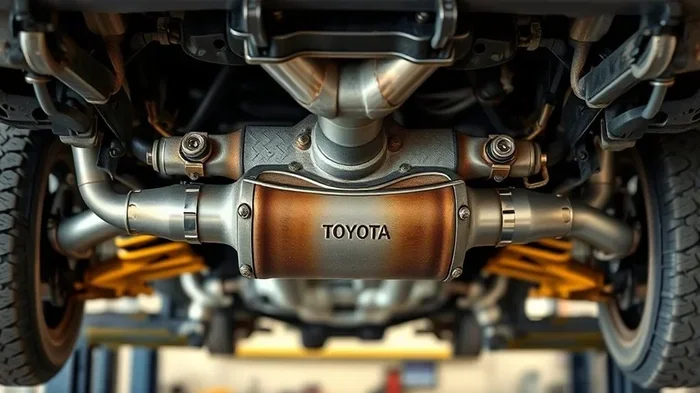
Look under the vehicle. If you can safely get underneath your Toyota, you can see the exhaust system. A single converter looks like one large oval or round canister. A dual converter setup shows two separate canisters connected by pipes. You may also see two pipes coming from the exhaust manifold.
Count the oxygen sensors. Toyota models with dual converters usually have more oxygen sensors. Each converter has at least one sensor before and one after it. So two converters means at least four oxygen sensors in the exhaust system. Check the wiring near the exhaust for clues.
Consult a mechanic. If you are still unsure, a quick visit to a trusted mechanic can tell you. They can look under your Toyota and confirm the setup in minutes. A good mechanic will also check for any issues with the converters while they are under there.
Check the VIN. Your vehicle identification number contains a lot of information about your Toyota. Service departments can decode the VIN to find exact specs, including converter count. This is especially helpful for older models or special trims.
Look up your model online. Toyota forums and parts websites often list exhaust system details by model and year. You can search for your specific Toyota and find the factory exhaust diagram. This shows exactly how many converters are in the system.
Knowing how many converters your Toyota has is important for several reasons. It helps you understand repair costs. It tells you what parts to order. And it gives you a baseline for troubleshooting exhaust problems.
Common Catalytic Converter Problems in Toyotas
Toyota catalytic converters are built to last a long time. In fact, Toyota owners often report converters lasting 100,000 miles or more. But like any car part, they can develop problems over time. Here are the most common issues Toyota owners face.
Clogging is the number one problem. Over time, carbon buildup can block the converter. When this happens, exhaust flow gets restricted. You may notice reduced power, poor fuel economy, or a rattling sound. In serious cases, the engine may stall or refuse to start.
Overheating can damage the converter. If the engine runs rich (too much fuel), the converter gets very hot. This can melt the internal honeycomb structure. Once damaged, the converter cannot clean exhaust gases properly. A melted converter needs full replacement.
Oxygen sensor failure often goes hand in hand. The oxygen sensors tell the engine computer how much fuel to burn. If a sensor fails, the engine may burn too much or too little fuel. This puts extra stress on the catalytic converter and can shorten its life.
Physical damage from road debris is another common issue. The converter sits underneath the vehicle. Rocks, potholes, and debris can dent or puncture it. A damaged converter may leak exhaust gases before they are fully cleaned.
Coolant or oil leaks can contaminate the converter. If your Toyota has a head gasket leak or oil seal problem, fluids can enter the exhaust system. These fluids coat the inside of the converter and reduce its effectiveness. Fixing the source of the leak is the first step to saving the converter.
Check engine light warnings are often the first sign of converter trouble. If your Toyota’s check engine light comes on, do not ignore it. A mechanic can read the error codes and tell you if the converter is involved. Early detection can save you from a full replacement.
Toyota vehicles are known for lasting a long time. If you want to learn more about what makes Toyotas so durable, check out our article on do Japanese cars last longer than American cars. Understanding the bigger picture helps you take better care of your Toyota.
How to Prevent Catalytic Converter Problems
Good news: you can take steps to protect your Toyota converter. Regular maintenance is the best defense. Here are some tips that really work.
- Keep up with oil changes. Clean oil prevents contaminants from reaching the exhaust system.
- Fix engine misfires quickly. Unburned fuel can damage the converter over time.
- Use quality fuel. Cheap fuel with impurities can cause buildup inside the converter.
- Address check engine lights promptly. Early intervention prevents small problems from becoming big ones.
- Avoid short trips when possible. The converter needs time to reach operating temperature. Short trips keep it from working properly.
- Get regular exhaust inspections. A visual check can spot rust, damage, or leaks early.
Catalytic Converter Replacement Cost for Toyotas
Replacing a catalytic converter is not cheap. And if your Toyota has two converters, the cost goes up. Let us break down what you can expect to pay.
A single Toyota catalytic converter typically costs between $500 and $1,500 for the part alone. Labor adds another $100 to $300. So a single converter replacement runs about $600 to $1,800 total. This varies by model and location.
For dual converter systems, the cost roughly doubles. You are replacing two converters instead of one. Some Toyota models use expensive catalytic converters with high precious metal content. These can cost $2,000 or more for parts alone. Add labor, and you could be looking at $2,500 to $4,000 for a full dual converter replacement.
The good news is that Toyota converters tend to last a long time. Many owners never need a replacement during normal ownership. But if you do need one, the cost can sting. That is why prevention and early detection matter so much.
If you are dealing with a converter issue and wondering about repair costs, it helps to understand the mechanic side of things. Our article on do auto mechanics make good money explains why repair costs are what they are. Mechanics charge for their expertise, and that expertise is what keeps your Toyota running right.
Used converters also play a role in the cost discussion. If you are shopping for a used Toyota, the condition of the catalytic converter matters. You can find more information about what to look for in used Toyotas in our guide on 2nd hand cars under 2 lakhs. A good inspection before buying can save you from surprise repair bills later.
OEM vs Aftermarket Converters
When replacing a Toyota catalytic converter, you have two main options. OEM converters are made by Toyota or their approved suppliers. Aftermarket converters are made by third-party companies. Both have pros and cons.
- OEM converters: Fit perfectly, meet all emission standards, and carry Toyota warranties. They cost more but last longer.
- Aftermarket converters: Cost less and are easier to find. But quality varies widely. Some aftermarket converters do not last as long or meet emission standards.
For most Toyota owners, we recommend going with OEM. The extra cost is worth the reliability and peace of mind. Aftermarket converters can be a budget option, but do your research first.
Tips to Keep Your Toyota Catalytic Converter Healthy
Your Toyota catalytic converter works hard every time you drive. Taking care of it can save you hundreds of dollars in repairs. Here are some practical tips that make a real difference.
1. Follow the Toyota maintenance schedule. Toyota provides a detailed maintenance plan for every model. Sticking to it keeps your entire exhaust system in top shape. Regular services catch small problems before they become expensive ones.
2. Watch for warning signs. A rattling noise from underneath the car could mean a broken converter inside. Reduced power or poor fuel economy are also red flags. A rotten egg smell from the exhaust often points to converter failure. Do not ignore these signs.
3. Keep the engine tuned. A well-tuned engine burns fuel cleanly. This reduces the workload on your catalytic converter. Spark plug changes, air filter replacements, and fuel system cleaning all help.
4. Avoid rolling coal. Some truck and car enthusiasts modify their exhaust to produce dark smoke. This is terrible for catalytic converters. It dumps unburned fuel into the exhaust and destroys the converter quickly.
5. Use the right fuel. Always use the fuel grade recommended by Toyota. Higher octane fuel is not always better. But using fuel with too low an octane for your engine can cause problems that affect the converter.
6. Address exhaust leaks quickly. If you hear a hissing or ticking sound from the exhaust, get it checked. Small leaks can grow into bigger problems. And before they do, they can affect how the converter performs.
7. Consider fuel additives carefully. Some fuel system cleaners claim to clean catalytic converters. These can help in mild cases of carbon buildup. But they are not a cure for a failing converter. Use them as a supplement to regular maintenance, not a replacement for it.
Taking care of your Toyota means taking care of every part, big and small. The catalytic converter may not be the most exciting part of your car. But it is one of the most important for clean driving and passing emission tests.
Toyota has built a reputation for building vehicles that last. Part of that reputation comes from smart engineering in every system, including the exhaust. Whether your Toyota has one converter or two, understanding how it works helps you be a better owner.
The next time someone asks you, “do Toyotas have 2 catalytic converters,” you will know the answer. It depends on the engine, the model, and the year. Four-cylinder Toyotas usually have one. V6 and V8 models often have two. And hybrid Toyotas may have unique setups that are worth investigating further.
Regular maintenance is your best tool for keeping your Toyota converter healthy. Watch for warning signs. Fix problems early. And when replacement time comes, choose quality parts and trusted mechanics. Your Toyota will reward you with years of reliable, clean driving.
Understanding your vehicle is empowering. It helps you make smarter decisions about repairs, purchases, and maintenance. The more you know about your Toyota exhaust system, the better equipped you are to handle whatever comes your way on the road.
So take a moment to learn about your specific Toyota model. Check the manual. Talk to your mechanic. And keep this guide handy for reference. Your Toyota catalytic converter is working hard for you. Now you know how to return the favor.
Frequently Asked Questions
Can a Toyota with one catalytic converter be upgraded to two converters?
Yes, it is possible to upgrade a single converter Toyota to a dual converter system. This is often done to improve exhaust flow and meet stricter emission standards. However, it requires custom exhaust fabrication and may not be legal in all areas. Always check local emission laws before making changes to your exhaust system.
How long do Toyota catalytic converters typically last?
Toyota catalytic converters are known for their durability. Most last between 100,000 and 150,000 miles under normal driving conditions. Some owners report converters lasting even longer with proper maintenance. Factors like driving habits, fuel quality, and engine health all affect converter lifespan.
Is it safe to drive a Toyota with a bad catalytic converter?
Driving with a bad converter is not recommended. A failing converter can reduce engine performance and fuel economy. In severe cases, it can cause engine damage. Plus, a bad converter will cause your Toyota to fail emission tests. It is best to address converter issues as soon as they are detected.
Do Toyota hybrid models have different catalytic converters?
Toyota hybrid models can have unique exhaust setups because of their dual powertrain. The gasoline engine in a hybrid may have different exhaust routing than a conventional Toyota. Some hybrids use advanced converter designs for better efficiency. Check your specific hybrid model for details about its converter system.
Why are Toyota catalytic converters so expensive to replace?
Toyota converters are expensive because they contain precious metals like platinum, palladium, and rhodium. These metals are what make the converter work. Toyota also designs their converters to meet strict emission standards, which requires high-quality materials. The cost reflects both the materials and the engineering that goes into them.
Can I sell my Toyota if the catalytic converter is failing?
Yes, you can sell a Toyota with a failing catalytic converter. Many buyers look for used Toyotas for parts or projects. However, a bad converter will lower your car’s value significantly. Some buyers may factor in the cost of a new converter when making an offer. Be upfront about the condition to build trust with potential buyers.
=== CONCLUSION ===
The question of whether Toyotas have 2 catalytic converters does not have a one-size-fits-all answer. It depends on your engine type, model, and model year. Four-cylinder Toyotas generally use one converter, while V6 and V8 models often come with two. Understanding this difference helps you make smart decisions about maintenance, repairs, and parts purchases.
Your Toyota catalytic converter is a vital part of the exhaust system. It keeps your vehicle running clean and meeting emission standards. Taking care of it through regular maintenance can save you from costly replacements down the road. Watch for warning signs, fix engine problems quickly, and always use quality parts.
Now that you know the answer to “do Toyotas have 2 catalytic converters,” you are better equipped to understand your vehicle. Share this guide with fellow Toyota owners who might benefit from the information. A little knowledge goes a long way when it comes to keeping your Toyota in top shape for years to come.